
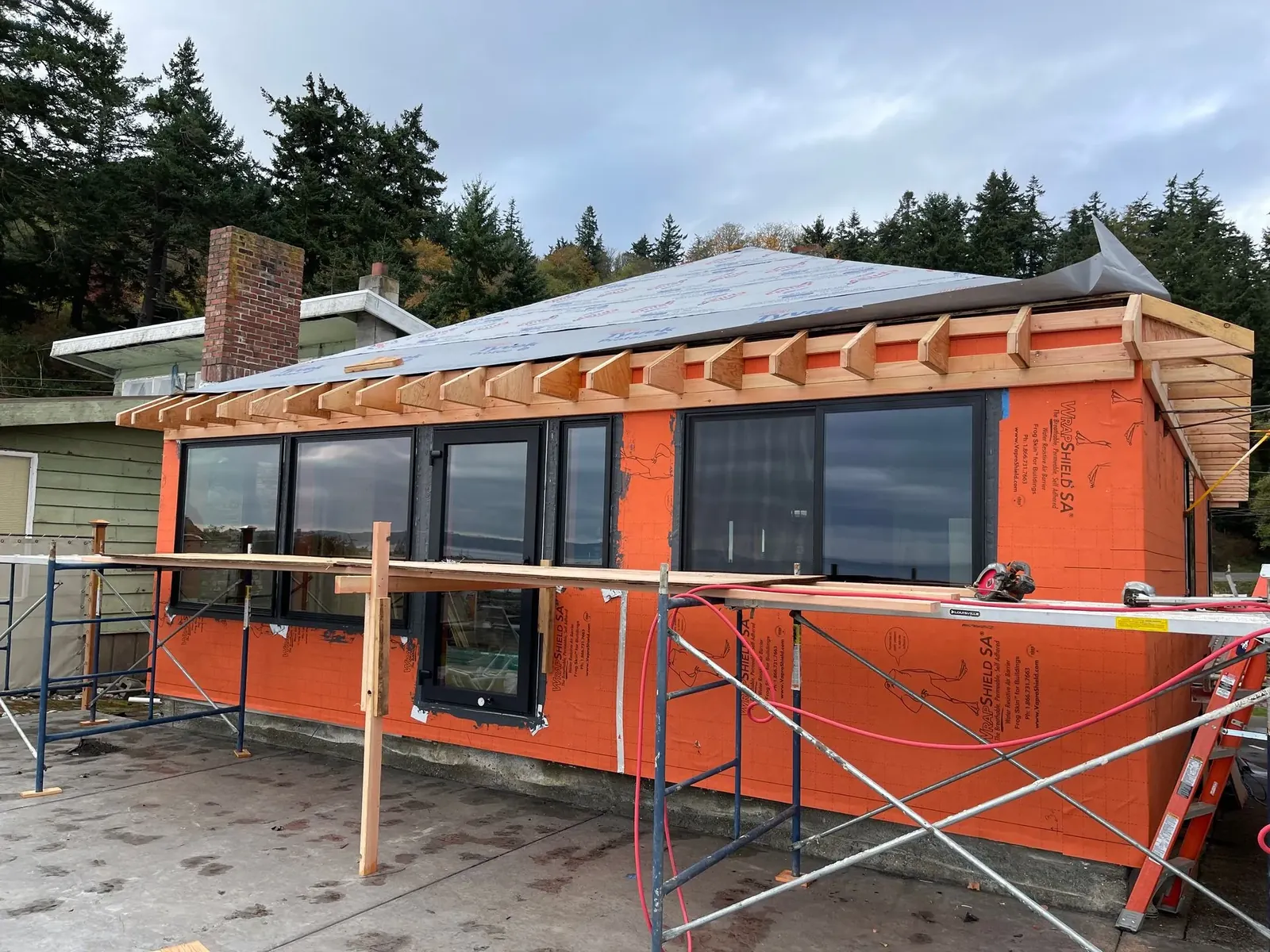
Owner-Builder or General Contractor: Can You Build Your Own House in Washington?
Yes. Washington’s contractor law exempts any person working on his or her own property, whether they live there or not. The exemption does not apply to work done for the purpose of selling, demolishing or leasing the property. State law also lets an owner do electrical and plumbing work on property he or she owns without a license.
The exemption covers registration only. The permit, the code, the inspections, the trades and the liens are still yours to run. Hiring a registered general contractor makes sense when you want one company to run all of it. Culver Built is a registered Washington general contractor based in Langley on South Whidbey Island.
Can you be your own general contractor in Washington?
Two exemptions in RCW 18.27.090 matter for an owner-builder.
- Working on your own property. Any person working on his or her own property is exempt, whether occupied by him or her or not. The line does not cover work done to sell, demolish or lease the property.
- Hiring registered contractors. An owner who contracts for a project with a registered contractor is exempt and keeps the law’s protections. It does not cover a contractor’s work to sell or lease improved property owned under twelve months.
The trades have owner exemptions of their own. RCW 19.28.261 lets you do electrical work on property you own without a license or a certified electrician. That exemption does not apply to a new building intended for rent, sale or lease. It also does not apply to property offered for sale within 12 months after obtaining it. RCW 18.106.150 lets you do plumbing work on property you own without a plumbing license.
The permit rules still apply. L and I says an electrical permit is required for most electrical work, whether you or a contractor installs it. Whoever does the electrical work gets the permit before starting. You must request the inspection before the work is covered. Ask your permit office which plumbing permits your job needs.
What does Island County ask of an owner-builder?
If no licensed Washington contractor is listed on the building permit, the owner must sign an Owner Contractor Form. The county’s FAQ says you are able to do the work yourself. The owner signs the form and submits it with the building permit application.
The rest of the submittal is the same for every new home. Island County wants a site registration and septic design, an approved access permit, an address and a water availability verification. Our Island County building permit guide covers each item. If your land is in Skagit County, see our Skagit County building permit guide.
Confirm the current form and list with the county before you apply.
What does an owner-builder take on?
Under RCW 18.27.010, a general contractor’s business requires more than one building trade or craft on a single job. A house takes many trades, so an owner-builder fills that role.
- The trades. You hire each trade, set the order of the work and keep materials coming. Every contractor you hire must be registered with L and I, bonded and insured.
- Workers you hire directly. L and I says you must provide workers’ compensation insurance for workers you hire directly. That covers new construction, remodeling work and property additions. If you hire someone who is not a registered contractor, you could be considered that person’s employer. That brings wage, tax, workers’ comp, safety and record-keeping requirements.
- The Washington State Energy Code. A new house earns energy credits from the code’s option tables: 5.0 for a small home under 1,500 square feet with under 300 square feet of windows, 9.0 for one over 5,000 square feet and 8.0 for every other house. The drawings you submit with the permit application must list the options picked and the point value of each. The State Building Code Council has proposed a newer energy code, so confirm the count when you apply.
- The inspections. Island County takes all building inspection requests through its Public Portal. Plan who will request each one as the work reaches it.
- The liens. L and I says the property owner is ultimately responsible for making sure suppliers, subcontractors and workers get paid. If a contractor you hire does not pay them, they have the right to file a lien on your property. Washington’s Notice to Customer warns you could pay twice for the same work. On an owner-builder job, you collect the lien releases yourself.
- Sales tax. The Department of Revenue says the prime contractor is generally the contractor hired by the owner of the land. A prime contractor collects retail sales tax from the landowner on the gross contract price. Each contractor you hire directly is working for the landowner, so expect sales tax on each contract.
What does a registered general contractor carry?
Washington requires all construction contractors to register with L and I and to be bonded and insured. The state sets these for every registered general contractor:
- Bond: a $30,000 surety bond, or $15,000 for a specialty contractor.
- Insurance: general liability of $200,000 public liability and $50,000 property damage, or a $250,000 combined single limit.
- Lien paperwork: Washington’s Notice to Customer (RCW 18.27.114) warns that an unpaid supplier, employee or subcontractor can lien your property. It says you may ask the contractor for original lien release documents from each supplier or subcontractor.
L and I’s contractor verification tool shows whether a registration is active. It also shows whether the contractor is bonded and insured. Use it on every contractor you hire.
How do owner-builder, general contractor and design-build compare?
| Question | Owner-builder | Hiring a general contractor | Design-build |
|---|---|---|---|
| Who schedules the trades? | You | The general contractor | The design-builder |
| Who is the contractor on the permit? | You, with an Owner Contractor Form in Island County | The registered general contractor | The design-builder, a registered contractor |
| Who carries the bond and insurance? | Each trade carries its own; you cover workers’ comp for workers you hire | The general contractor | The design-builder |
| Who handles lien releases? | You collect them from every trade and supplier | You may ask the contractor for them | You may ask the design-builder for them |
| Who answers when something goes wrong? | You sort it out with each trade | The general contractor | The design-builder, for the design and the build |
Design-build puts design and construction under one contract. See how our design-build process runs, or read design-build vs design-bid-build.
Can you get a construction loan as an owner-builder?
Lenders set their own rules for owner-builders, so ask yours before you buy land. Questions to bring:
- Do you lend to owner-builders, or only on jobs run by a registered contractor?
- What do you need to see, such as plans, a line-item budget, a schedule or your building experience?
- How and when do you release money during construction?
- Does someone inspect the work before each payment?
When does hiring a general contractor make sense?
Being your own general contractor skips the contractor’s fee. You take on the work that fee pays for: scheduling, supervision, payments and lien releases. Our guide to how much a general contractor charges in Washington covers what the fee includes.
A general contractor fits when the job takes many trades and you cannot be on site every day. It also fits a custom home on raw land, where site work, septic design and the permit must line up. If you own a lot, see how we build on your land.
Would you rather hand the job to one contractor?
Culver Built is licensed, bonded and insured, with more than 30 years of building experience. As your general contractor, we hold the contract and schedule the licensed trades. Our own equipment handles the site work. See how we work as your general contractor, or call or text (360) 544-9027 for a free estimate.